VapoCept (Customer Feedback Explained) Reviews Complaints
VapoCept Reviews Complaints is one such product that has generated interest—and, like many supplements, it has also prompted questions about ingredients, possible side effects, customer complaints!
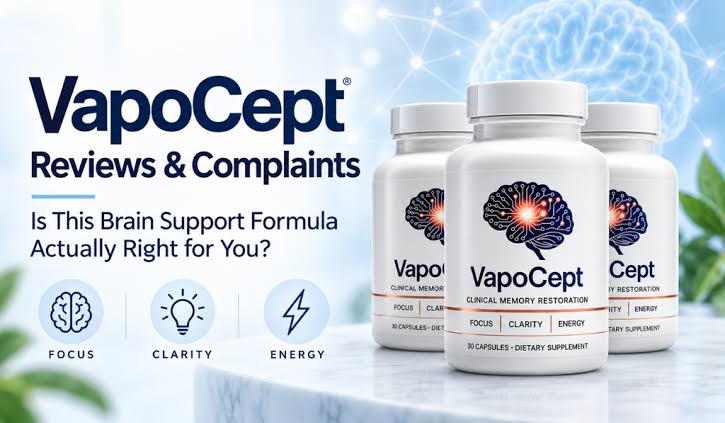
VapoCept (Cognitive Wellness Review) Complaints: A Detailed Assessment of Memory Claims, Focus Support, Customer Opinions, Product Quality & Value!
👉𝔾𝔼𝕋 𝕄𝕆ℝ𝔼 𝕀ℕ𝔽𝕠: — ℂ𝕝𝕚𝕔𝕜 𝕆ℕ ℍ𝔼ℝ𝔼 𝕆𝕗𝕗𝕚𝕔𝕚𝕒𝕝 𝕎𝕖𝕓𝕤𝕚𝕥𝕖👈
Buying a supplement online can feel surprisingly complicated.
You see a product promising better focus, improved memory, greater mental clarity, or more energy. The ingredient list looks scientific. There are positive testimonials.
There may also be negative reviews mentioning disappointing results or other concerns.
Then comes the obvious question:
Is VapoCept actually worth trying, and what should you know before buying it?
VapoCept has attracted attention as a supplement marketed around cognitive and performance-related benefits.
At the same time, prospective buyers have raised questions about reported side effects, customer complaints, ingredients, expected results, and the transparency of the information available online.
The most useful way to approach these questions isn't to automatically believe either the positive or negative claims.
Instead, it is to look at what can actually be established.
VapoCept at a Glance
VapoCept is marketed as a dietary supplement designed to support areas such as mental focus, clarity, memory, and energy.
Information associated with the product lists several ingredients, including:
L-arginine
L-arginine AKG 2:1
L-citrulline HCl
L-citrulline malate
Niacin
Beta-alanine
At first glance, these ingredients may sound familiar to people who have researched sports or nutritional supplements.
But there's an important distinction that every supplement shopper should understand:
An ingredient can have research behind it without the finished product having equivalent clinical evidence.
That distinction matters when evaluating almost any supplement.
Why People Search for VapoCept Side Effects
Searching for "VapoCept side effects" doesn't necessarily mean someone has already experienced an adverse reaction.
Often, it simply means a potential customer is doing what they should do before taking a new supplement: researching possible risks.
That's a good habit.
Dietary supplements can have biological effects, and the FDA notes that supplements can interact with medications and may cause adverse effects in some circumstances.
The fact that a product is sold as a supplement does not automatically mean it will be appropriate for everyone.
At the same time, it's important not to turn every possible ingredient reaction into a confirmed VapoCept side effect.
There appears to be limited independent clinical evidence specifically establishing the side-effect profile of the finished VapoCept formula.
That means claims found on review sites, forums, or promotional pages need to be interpreted carefully.
👉𝔾𝔼𝕋 𝕄𝕆ℝ𝔼 𝕀ℕ𝔽𝕠: — ℂ𝕝𝕚𝕔𝕜 𝕆ℕ ℍ𝔼ℝ𝔼 𝕆𝕗𝕗𝕚𝕔𝕚𝕒𝕝 𝕎𝕖𝕓𝕤𝕚𝕥𝕖👈
Potential Ingredient-Related Reactions
One way to understand possible concerns is to examine the ingredients individually.
Niacin
Niacin, or vitamin B3, is an essential nutrient involved in normal metabolic processes.
However, certain forms and doses of niacin can cause flushing—a temporary sensation of warmth, redness, or tingling.
Whether that is relevant to someone taking VapoCept depends on the specific amount and form included in the product.
This is one reason complete dosage information matters.
Beta-Alanine
Beta-alanine is commonly associated with sports nutrition.
At sufficiently high doses, it can cause paresthesia, which is often described as tingling or a pins-and-needles sensation.
Again, that does not mean someone taking VapoCept will necessarily experience this reaction. The amount consumed and the individual's response are important factors.
Arginine and Citrulline
L-arginine and L-citrulline are amino-acid compounds involved in pathways associated with nitric oxide and blood flow.
They are used in various nutritional and sports supplements.
But the presence of these ingredients doesn't, by itself, prove that VapoCept will improve memory, concentration, or cognition.
The scientific question is always more specific:
What dose was studied, in what population, for what outcome, and does the VapoCept formulation provide a comparable amount?
The Dosage Question
This may be one of the most important issues for consumers evaluating VapoCept.
Ingredient names alone don't tell the whole story.
Imagine two supplements containing exactly the same six ingredients. One contains quantities supported by relevant human studies; the other contains very small amounts.
They may have identical ingredient lists, but they aren't necessarily equivalent.
That's why consumers should look for a Supplement Facts panel that clearly identifies the amount of each active ingredient.
When individual quantities aren't readily available, it becomes difficult to compare the formula with published research.
This doesn't automatically demonstrate that a supplement is ineffective or unsafe.
It simply means there is less information available for an informed purchasing decision.
What Are People Complaining About?
Customer complaints surrounding supplements can generally fall into several categories.
Some consumers complain about effectiveness.
They may have purchased a product expecting a noticeable improvement and found that the results weren't what they expected.
Others may have concerns about price or value.
A third category involves customer service, shipping, billing, or refunds.
And then there are reports concerning physical reactions or other personal experiences.
These categories shouldn't all be treated in the same way.
👉𝔾𝔼𝕋 𝕄𝕆ℝ𝔼 𝕀ℕ𝔽𝕠: — ℂ𝕝𝕚𝕔𝕜 𝕆ℕ ℍ𝔼ℝ𝔼 𝕆𝕗𝕗𝕚𝕔𝕚𝕒𝕝 𝕎𝕖𝕓𝕤𝕚𝕥𝕖👈
A shipping complaint is a customer-service issue.
A complaint about no noticeable benefit is an individual experience.
A report of a physical symptom is potentially a safety issue, but it still doesn't establish causation by itself.
That distinction is important.
Why Online Reviews Can Be Misleading
Online reviews are useful—but imperfect.
Consider two people who take the same supplement.
One reports feeling more energetic.
The other notices no difference.
Neither experience necessarily tells us how the product performs for the average consumer.
There are simply too many variables.
Sleep quality, diet, caffeine intake, exercise, stress, medications, expectations, and underlying health conditions can all affect how someone feels.
Reviews can also be influenced by when the review was written and why the person purchased the product in the first place.
This doesn't mean reviews should be ignored.
Instead, they should be treated as consumer experiences rather than clinical evidence.
Marketing Claims vs. Scientific Evidence
This is perhaps the biggest issue when evaluating cognitive supplements.
Marketing tends to focus on outcomes.
Science focuses on evidence.
A marketing page might suggest that a product supports memory, focus, circulation, energy, or mental performance.
A scientific study asks much narrower questions.
For example:
How many people were studied?
Was there a placebo group?
How long did the study last?
What dose was used?
What outcome was measured?
Was the result statistically and clinically meaningful?
Can the result be reproduced?
Those questions aren't as exciting as a dramatic testimonial, but they're much more useful when deciding whether a product deserves your money.
Can You Expect Dramatic Results?
Probably not something you should assume.
Consumers should be cautious whenever a supplement appears to promise dramatic improvements in memory, concentration, or overall cognitive ability.
Individual responses to supplements vary considerably.
Even if an ingredient has evidence supporting a particular physiological effect, that doesn't guarantee a noticeable improvement in everyday cognitive performance.
A realistic expectation is more appropriate.
Don't purchase a supplement assuming it will completely transform your concentration or memory.
👉𝔾𝔼𝕋 𝕄𝕆ℝ𝔼 𝕀ℕ𝔽𝕠: — ℂ𝕝𝕚𝕔𝕜 𝕆ℕ ℍ𝔼ℝ𝔼 𝕆𝕗𝕗𝕚𝕔𝕚𝕒𝕝 𝕎𝕖𝕓𝕤𝕚𝕥𝕖👈
Instead, evaluate what evidence exists and consider whether the potential benefit justifies the cost and uncertainty.
Is VapoCept FDA Approved?
This is another area where terminology matters.
Dietary supplements in the United States aren't regulated in exactly the same way as prescription medicines.
The FDA explains that it generally does not approve dietary supplements for safety and effectiveness before they are marketed.
Therefore, consumers should be skeptical of language that makes a supplement sound as though the FDA has evaluated and approved it as an effective treatment.
"FDA regulated," "FDA registered," and "FDA approved" are not interchangeable terms.
Understanding that difference can help consumers recognize misleading marketing language.
Who Should Be Especially Careful?
Certain people should be particularly cautious about starting a new supplement without professional advice.
That includes people who:
Take prescription medications
Take multiple supplements
Have an existing medical condition
Are pregnant or breastfeeding
Have experienced reactions to supplements previously
Are preparing for surgery
The reason is simple: supplements can interact with medications or have effects that aren't appropriate for everyone.
If you have concerns about whether VapoCept is appropriate for you, a doctor or pharmacist can provide advice based on your individual circumstances.
What to Do If You Experience a Reaction
If you develop an unexpected or significant reaction after taking a dietary supplement, don't assume that you should simply continue using it.
The FDA recommends stopping use and seeking medical advice when an adverse event occurs.
For severe symptoms, seek urgent medical attention.
It's also useful to keep the product packaging and ingredient information available. If a healthcare professional needs to evaluate the reaction, knowing exactly what was consumed can be helpful.
A Practical VapoCept Buying Checklist
Before purchasing VapoCept—or any supplement—ask yourself a few questions.
1. Can I verify the complete ingredient list?
Don't rely only on an advertisement or a shortened ingredient summary.
2. Are the quantities clearly disclosed?
Knowing the amount of each active ingredient makes the product much easier to evaluate.
3. Is there research on the finished product?
Research on individual ingredients isn't necessarily evidence that the complete formula produces the same results.
4. Who is actually selling it?
Verify the seller and make sure you understand where your purchase is coming from.
5. What happens if I change my mind?
Read the refund and return policy before purchasing.
6. Are there recurring charges?
If you're purchasing through a subscription or recurring-order offer, make sure you understand how future billing works.
👉𝔾𝔼𝕋 𝕄𝕆ℝ𝔼 𝕀ℕ𝔽𝕠: — ℂ𝕝𝕚𝕔𝕜 𝕆ℕ ℍ𝔼ℝ𝔼 𝕆𝕗𝕗𝕚𝕔𝕚𝕒𝕝 𝕎𝕖𝕓𝕤𝕚𝕥𝕖👈
7. Does the marketing sound too good to be true?
Claims of dramatic or guaranteed health improvements deserve extra scrutiny.
The Bigger Lesson for Supplement Shoppers
VapoCept isn't unique in raising these questions.
The same principles apply to almost every supplement sold online.
A sophisticated-looking website doesn't prove effectiveness.
A long ingredient list doesn't prove effectiveness.
A large number of testimonials doesn't prove effectiveness.
And a handful of negative reviews doesn't prove that a product is dangerous.
The real question is always:
How strong is the evidence, and how transparent is the company about what consumers are actually getting?
That mindset can save consumers both money and disappointment.
Final Thoughts
VapoCept may appeal to people looking for additional support for focus, memory, clarity, or energy. Its formula includes ingredients that are familiar within the broader supplement market.
However, prospective buyers should distinguish between ingredient research, marketing claims, customer testimonials, and evidence specifically supporting the finished product.
Reported complaints can be worth investigating, but they shouldn't automatically be treated as confirmed medical facts. Similarly, positive reviews shouldn't be treated as proof that everyone will experience the same benefits.
Before buying, look carefully at the label, ingredient quantities, seller information, refund terms, and available evidence.
And if you're taking medication or have a medical condition, consider discussing the product with a healthcare professional first.
In an online supplement market filled with bold promises, the smartest approach isn't to be automatically positive or automatically negative.
It's to be curious, skeptical, and informed.
That's ultimately what makes a better buying decision.